

Penchantment
1920s John Hancock Cartridge Filling Fountain Pen - FLEX
1920s John Hancock Cartridge Filling Fountain Pen - FLEX
Couldn't load pickup availability
Vintage: 1920s
Make: John Hancock
Model: Cartridge Filling Pen
Color: Black, red ripple
Materials: Black Hard Rubber, ripple HR, nickel-plated trim
Filling System: Cartridge filler (filled by syringe) fully operational with no leaks
Length: This Continental model has a standard girth and measures 4 7/16” capped and 5 7/8” posted.
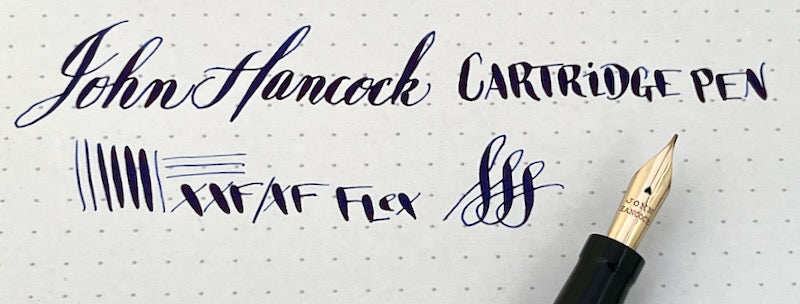
Nib: Flexible 14k John Hancock nib lays down a smooth and consistent XXF/XF line that widens to a 3B+ (approx 1.7mm) under moderate pressure.
Condition: Near mint. This pen resembles a time-capsule relic. Hard rubber retains its factory black color with no discernible fading. HR surface is smooth and lustrous with no deep scratches or other noteworthy blemishes. Nickel-plated clip has no brassing and the only notable flaw is a short scratch in the center that doesn’t penetrate the plating. Elaborate manufacturer imprint on the cap is factory deep and fully legible. Cartridge threads have been cleaned and greased and pen fills and writes with no leaks.
Details: John Hancock pens were manufactured by the Pollock Pen Company of Boston, founded in 1921 by the man who patented their innovative design, Robert T. Pollock. Pollock brought the titans of industry onboard as investors. And the company’s board of directors featured the likes of King C. Gillette of the Gillette Safety Razor Company as well as Louis K. Liggett of the United Drug Company. Although it was by no means the first cartridge-filling pen on the market, it was advertised as “the biggest piece of fountain pen news in over 40 years” (for more great info, see Richard Binder’s JH profile). Hyperbole aside, the design *is* a marked improvement over earlier cartridge fillers and more durable even than Waterman’s glass cartridge pens of the 1940s. In place of glass with a rubber seal that could fail, a JH cartridge is made of copper with tapered, leak-proof threads that screw into the back of the section. Originally, one could purchase new cartridges full of ink. But since these are obviously in low supply these days, the original cartridge can be reused by refilling it. To fill one simply unscrews the blindcap and cartridge, refills the cartridge with a syringe, then screws it back into the pen (open side up!) while applying a little pressure to ensure a good seal. Manufactured in low numbers for less than a decade and prized by collectors as an interesting wrinkle in FP history, John Hancock pens are quite hard to come by today.